

Pittsburgh Pirates 2026 Statcast Bat Tracking Metrics: Part Two
Full Profiles for Every Hitter on the Pirates

Yesterday, I dove into the Statcast Bat Tracking data, giving a look at every member of the 2026 Pittsburgh Pirates.
I had some previous experience with bat speed and swing length data, so that article went into more detail on those metrics for most of the players on the roster.
Prior to this article, I didn’t have much experience looking at the rest of the Bat Tracking data. What better way to get a first look than to break down the 2026 Pirates hitters?
Below are the remaining Bat Tracking stats: Squared-Up rates, Blast rates, swing path, attack angle, attack direction, and attack angle rate. I finished the article with a profile on every hitter, plus an overall look at the 2026 offense.
If you missed part one, check that out before diving into today’s conclusion.
Pittsburgh Pirates 2026 Statcast Bat Tracking Metrics: Part One

I have been waiting for this for a long time.
Squared-Up Contact Rate and Swing Rate
“A swing’s squared-up rate tells us how much of the highest possible exit velocity available (based on the physics related to the swing speed and pitch speed) a batter was able to obtain – it is, at its simplest, how much exit velocity did you get as a share of how much exit velocity was possible based on your swing speed and the speed of the pitch.”
MLB Average: 32.8% Contact / 25.0% Swing
These stats are interesting. They demonstrate an efficiency of maximizing the available exit velocity. There are two stats. One tracks the squared-up rate by contact, and the other by overall swings. Each tells a different story.
Oneil Cruz, for example, has an above-average contact rate of 35.7%, but a below-average swing rate of 22.2%. This means Cruz, with all of his swing and miss, doesn’t maximize exit velocity on every swing. When he makes contact, he maximizes that exit velocity at an above-average rate.
Spencer Horwitz excels in this department. He leads the team in both contact and swing rates. He also ranks 10th in the Majors in contact and 12th in swing rate. While Horwitz lacks power production from a slow bat speed, very few barrels, and a low exit velocity, he does square up on the ball. If he ever found the barrel more frequently with this trend, he’d add some valuable power to his game.
Ryan O’Hearn, Jared Triolo, and Nick Yorke are the other players with above-average rates on both sides. Everyone else on the team has below-average rates on both sides.
This feels more like a control stat than a power stat. With the exception of Cruz, the hitters who excel in this area all have below-average bat speeds and below-average fast swing rates. The next set of metrics gets more into the power.
Blast Contact Rate and Swing Rate
“A blast, in Statcast terms, is when a batter squares up a ball and does so with a high bat speed.”
MLB Average: 14.2% Contact / 10.8% Swing
When paired with the last set of metrics, the blast contact rate and swing rate will show who is maximizing their exit velocity with a power swing.
Again, Cruz leads the way here, which isn’t a surprise. His 26.2% contact rate is almost 10 percentage points higher than the second best on the team, which is Yorke. His 16.3% swing rate is first, despite the swing and miss reducing his contact opportunities. Cruz ranks third in the majors in blast contact rate, and 18th in blast swing rate.
Behind Cruz, the Pirates have four hitters with above-average rates on both sides: Yorke (17.6 / 15.0), Brandon Lowe (16.9 / 11.8), Marcell Ozuna (16.0 / 11.5), and Bryan Reynolds (14.9 / 10.9).
O’Hearn, Konnor Griffin, Henry Davis, and Joey Bart are all around average on both sides.
On the low end, Horwitz (12.2%), Triolo (12.1%), Nick Gonzales (9.3%), and Jake Mangum (5.2%) are all well below-average in blast contact.
These stats really separate the power hitters from the contact hitters, especially when compared to the squared-up rates. Horwitz and Triolo were both above-average with squared-up rates, but below-average with blast rates. This continues an observation I made on Thursday about Triolo, which is that he has more of a defensive swing that reacts, versus a more aggressive cut like Davis.
Meanwhile, Davis is one of the worst in the squared-up rates (26.8% contact rate), but average with the blast rates, showing his swing is geared more toward power.
The more I dive into these numbers, the more respect I have for Cruz developing into one of the most dangerous hitters in the game.
Swing Path
“Swing path is a metric that tells you the shape of a hitter’s swing on the way toward contact. The tilt of the swing is defined as the vertical angle formed by the bat path compared to the ground.”
MLB Average: 32
This is actually the stat I was looking forward to the most. It’s also where I might do some future league-wide research.
The swing path tracks the vertical angle of the swing. The zero degree angle starts at the head, with a swing that travels parallel to the ground. The steeper the angle, the more a swing turns into a golf club swing. This is measured during the 40 milliseconds prior to contact.
Almost every Pirates hitter has a tilt of 32 or more. The exceptions are Billy Cook (28) and Davis (27). The extreme cases are Reynolds (39), Triolo (38), and Ozuna (37). I’m surprised that Cruz is only at 34, considering how tall he is and how often he has an almost vertical swing on inside pitches.
I don’t have numbers to back this up, but my theory is that less tilt does better at the top of the zone and on outside pitches, while more tilt does better low and inside. Less tilt would benefit from four-seam fastballs and horizontal breaking pitches, while struggling against sinkers and vertical breaking pitches. More tilt would have the opposite impact, especially benefitting against sinkers.
There is also the angle and direction to consider, which I’ll detail below, before building a full profile for each hitter.
Before I continue, I want to provide a visual guide to each concept from Baseball Savant, using Cruz as an example.
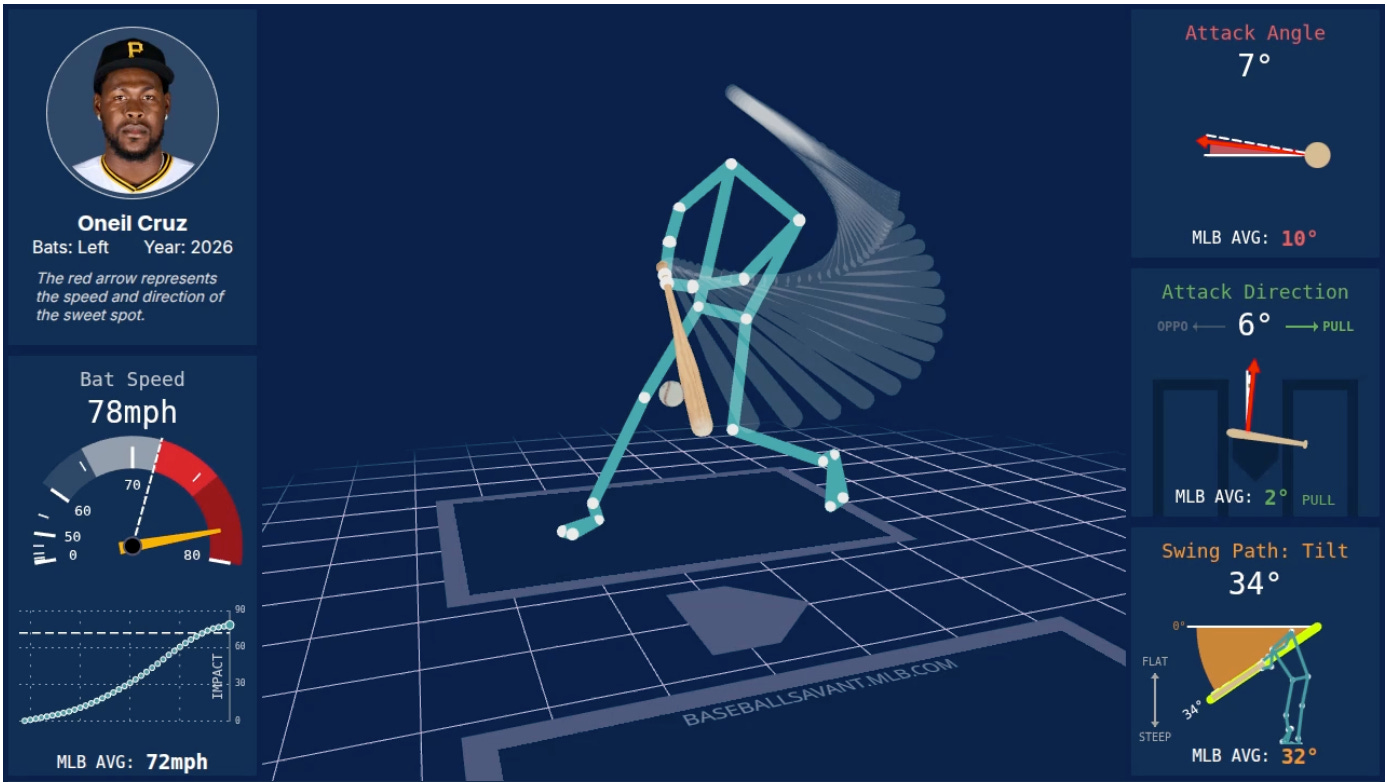
Attack Angle
“Attack angle measures the vertical direction that the sweet spot of the bat is traveling at the moment it hits the baseball.”
MLB Average: 10
The attack angle almost corresponds to the old theory of launch angle and lift. The Pirates have four hitters with above-average attack angles: Ozuna, Lowe, Cook, and O’Hearn. Reynolds is right at average. Cruz is surprisingly below-average, while Triolo (3), Yorke (2), and Mangum (1) are well below-average.
What I find interesting here is the correlation between ground ball rates and attack angle. Mangum has the highest ground ball rate on the team. Yorke is third. Triolo is ninth, but also ninth in line drive and sixth in fly ball rate. Those low attack angles tend to lead to heavy ground ball tendencies.
Meanwhile, out of the higher attack angles, Ozuna stands out with the lowest ground ball rate to pair with his team-leading attack angle. Lowe and O’Hearn are bottom four in ground balls. Cook has a higher ground ball rate, but a 33% line drive rate, which leads the team. Ozuna, Lowe, and O’Hearn are all top-five in line drive rates, which are most likely to fall in for hits.
The higher attack angle is a good thing, as it avoids hitting the ball into the ground, which is horrible for power, and subjects you to BABIP performance.
Attack Direction
“Attack direction measures the horizontal direction that the sweet spot of the bat is moving at the point of contact with the baseball (or the point the bat and ball cross paths on a swing-and-miss).”
MLB Average: 0
The attack direction breaks down whether a hitter is a pull hitter or an opposite field hitter.
The Pirates have three hitters around zero: Griffin, Gonzales, and O’Hearn.
Cruz, Lowe, and Horwitz are left-handed pull hitters, with Cruz having the most extreme result at 6 degrees. That’s great for his power production at PNC Park.
On the right side, Davis, Ozuna, and Cook are extreme pull hitters, which doesn’t work well at PNC Park. Triolo and Yorke are opposite field hitters in the 5-7 degree range.
Reynolds is a switch hitter who works opposite field from both sides, with a more extreme angle from the right side, and only 2 degrees from the left.
Mangum is also a switch hitter who has an extreme 14 degree opposite field angle from the left side, and only 5 degrees opposite field from the right. The left side opposite field approach takes away his advantage of being a lefty hitter in PNC Park.
Ideal Attack Angle Rate
“A hitter’s ideal attack angle rate is the percentage of his competitive swings that fall within the 5-20 degree attack angle range.”
MLB Average: 51.3%
The ideal attack angle metric is interesting, because the results don’t correlate with good performances. Only two Pirates have above-average rates. Those are Davis and Ozuna. They are also in the top four in fly balls, which makes sense considering the metric.
At the low end are Triolo, Yorke, and Mangum, who I identified earlier as players who put the ball on the ground more often.
I don’t think this stat individually points to success, but it does show which hitters consistently attack the ball at an angle that avoids ground balls or weak fly balls. At best, it’s a stat that shows who is avoiding a poor contact approach.
Hitting Profiles
After three days of highlighting the swing decisions and contact, plus the bat speed data and today’s Bat Tracking details, I’ve got a better view on each hitter on this offense. Below is a summarized profile of each player.
Oneil Cruz - Cruz is the best power hitter on the team, and one of the best in the league. He ranks top five in the Majors in bat speed, fast swing rate, and blast contact. He has above-average tilt, below-average attack angle, and a six-degree pull side attack direction that plays well at PNC Park as a lefty. He’s got a below-average ideal attack angle rate, with his average of 7 degrees sitting at the low end of the 5-20 range. There are some swing and miss issues, which might come from swing length or one of the most aggressive fast swing approaches in the game. Cruz still puts up great results with those issues in place.
Brandon Lowe - The power from Lowe has been impressive this season. He ranks second to Cruz on the team in blast contact rate. His attack angle is tied for first on the team at 15, and he ranks fourth with a 49% ideal attack angle rate. His bat has above-average tilt, and he’s got some pull side direction, which helps at PNC Park. His swing is geared toward putting the ball in the air, pull-side, and he’s efficient at maximizing exit velocity with hard swings.
Ryan O’Hearn - One of the most well-rounded hitters on the team, O’Hearn lacks a fast bat, but is one of the best at squaring up on the ball. He has average tilt, an above-average attack angle, and a neutral direction, which should translate to the ideal ability to hit line drives to the middle of the field. His bat speed is slow, and he doesn’t catch a lot of barrels. He does hit for some power, while showing some of the best swing decisions and contact abilities on the team.
Bryan Reynolds - He doesn’t stand out in any single category, but Reynolds is a well-rounded hitter with some power. He’s got the largest bat tilt on the team, along with a league average attack angle. His directional angle is neutral, showing all-fields abilities. While Cruz and Lowe stand out for the power production, O’Hearn and Reynolds stand out for their ability to provide consistent production. This is fueled by swing decisions and contact ability that has some power potential.
Konnor Griffin - The young rookie not only has one of the longest swings on the team, but one of the quickest and most consistently fast bat speeds. He ranks in the bottom half of the team in squared-up and blast swing rates, which is due to some swing and miss issues. Those issues aren’t as extreme as Cruz, but he also doesn’t have the extreme power production to match. Griffin has average bat tilt, around average attack angle, and around neutral directional angle. There’s a lot of potential here, but it’s mostly untapped. Griffin might actually benefit from scaling back from the long, power swing and going for more contact to maximize his speed and natural power. For now, he’s too young and new to be making any changes. He’s still in the early stages of establishing a sample size of what type of hitter he can be.
Nick Gonzales - Gonzales is an interesting case. He’s one of the rare hitters with an above-average swing length and below-average bat speed. He rates in the bottom half for squared-up and blast rates. He has above-average tilt, around average attack angle, and neutral direction. There’s not much here that shows Gonzales being anything more than a good contact hitter. He has shown improvements with his swing speed variance, which has led to reduced swinging strikes and better contact rates. He’s a safe contact hitter who lacks power, but he’s been on a tear lately. That, unfortunately, is fueled by a high BABIP, which means he could be a streaky hitter who is currently in a hot streak.
Spencer Horwitz - It’s a bit of a problem that Horwitz has some of the worst power production numbers on the team in many categories. That includes one of the slowest bat speeds, one of the lowest blast rates, and one of the lowest barrel rates. He does excel at squaring up on pitches, leading the rest of the team by a good range. Horwitz has above-average tilt, around average angle, and some pull to his direction. He looks like a better contact hitter than Gonzales, with the downside being that Horwitz plays a power position.
Henry Davis - There are some issues that stand out with Davis. He’s got one of the fastest swings, but some of the worst squared-up rates. His fast swings don’t translate to good blast rates, showing he’s not making efficient contact when he swings hard. His swing speed sits in a tight, consistent range that could be predictable. His tilt is below-average, with a more horizontal swing. He does hit the ideal attack angle better than anyone on the team. What I find interesting is he’s attacked in the zone more than anyone else on the team. He also sees the highest sinker rate on the team, and one of the lowest four-seam rates. With a swing that is more horizontal and predictable in speed, Davis is a hitter that pitchers can attack with well-timed vertical movement in the zone.
Marcell Ozuna - A lot of the metrics from Ozuna point to an aging power hitter who is starting to slip below-average in every aspect of what leads to power. He does still make good blast contact, but his bat speed has dropped, and his contact rate has been declining, especially out of the zone. Ozuna does have an above-average attack angle with above-average bat tilt. He’s got one of the best attack angle rates on the team. However, the three hitters who are above-average in this stat aren’t putting up good numbers this year, despite their power potential. At best, he’s still got the ability to put the ball in the air, with less force behind it, which will subject him to the lowest BABIP odds.
Jared Triolo - Triolo excels at making contact, but it’s not quality contact. He’s got some of the worst power production on the team, with one of the lowest fast swing rates, and low blast rates. He squares up on the ball better than most on the team, and is one of the more disciplined hitters. However, he’s got a well-below average attack angle, which means he’s prone to putting the ball on the ground more than most. He’s got a defensive swing that is geared toward reactionary contact, versus proactive attack force. That’s his entire game, which works well on the field, but not so much at the plate.
Nick Yorke - I was wondering why Yorke was struggling so much, despite promising plate patience and power metrics. Then, I noticed he had one of the worst attack angles, which leads to one of the highest ground ball rates on the team. He also has one of the lowest barrel rates. It doesn’t matter if Yorke is swinging fast with good swing decisions if he’s just pounding the ball into the ground by missing the sweet spot. He could be a swing adjustment away from locking everything in. That adjustment would likely require a better attack angle that allows him to catch the barrel more often, while putting the ball in the air.
Joey Bart - I didn’t focus on Bart that much during this series. He’s got one of the fastest bat speeds, highest fast swing rates, and he’s above-average with blast rates. His squared up rates are among the worst on the team. He has one of the better barrel rates on the team, but he doesn’t hit the ball consistently hard. He’s average, at-best, when it comes to contact. His attack angle is neutral, and he has right-handed pull tendencies that don’t work for PNC Park. There’s not much that stands out, except for some power potential that is neutralized by inconsistent contact abilities.
Billy Cook - Cook has one of the longest swing lengths on the team, but ranks around middle of the pack in bat speed. He’s got some of the lowest squared-up rates, and some of the lowest blast rates. He also has one of the highest swing and miss rates. It’s a small sample size, but Cook’s swing looks statistically flawed, with a power approach that might have worked in the minors, but won’t work in the majors. He has the second-most horizontal swing on the team, and is one of the leaders in attack angle rate. His pull-side direction is a detriment at PNC Park. He probably would benefit from a shorter, more controlled swing that is less focused on power and more focused on contact.
Jake Mangum - Mangum is one of the weaker hitters on the team in terms of power, but also in terms of contact this year. He’s got the slowest bat speed, lowest fast swing rate, shortest swing, lowest blast rates, lowest squared-up rates, and his attack angle is the lowest on the team. This all results in an extreme 69.2% ground ball rate that leads the Majors. He’s a switch hitter, but has opposite field direction from the left side, which removes his benefit at PNC Park. I liked Mangum with the Rays last year as a defensive outfielder with speed who could make good contact. The biggest change to his game this year is a severe decline in squaring up on the ball, with more tilt added to his swing, and an increase in an already extreme ground ball rate. He still holds the fourth outfield profile, but he has taken a step back this year on a contact-based offensive profile with weaker contact.
The 2026 Pittsburgh Pirates Offense
It has only been a little over a month, but the biggest surprise of the season has been the Pirates ranking as the seventh-best position player group in the Majors. That’s a value that comes with below-average defense and top-ten offense.
The standout performances are the seventh-best on-base percentage and the second highest base running value. They have middle-of-the-pack power, and rank top ten in average, with a top-five BABIP. The latter could be due to the speed and patient contact abilities.
Cruz and Lowe stand out as the power hitters on the team. O’Hearn and Reynolds are the more consistent, well-rounded hitters who can provide power. Griffin is showing potential to add another dynamic bat to the mix. Gonzales has been putting up great contact abilities at times.
The offense does have some holes. The catching position is the weakest spot, with Davis possibly needing a swing overhaul, and Bart lacking contact abilities to maximize his power. The Pirates are hurt by the decline of Ozuna at the DH role, and they’re rolling with a contact-heavy, low-power first base option in Horwitz. When O’Hearn plays first base, he’s replaced with a contact-heavy option in Mangum, or guts like Cook or Yorke who have swing issues to deal with.
The biggest downside is Ozuna. There are a lot of signs that he’s declining at an older age. The $12 million spent on him this offseason already looks like a sunk cost. If the Pirates want to upgrade their offense this season, they’re going to have to commit more resources to his spot as the area with the most potential upside. They could also target a right-fielder, move O’Hearn to first base, and have Horwitz batting off the bench and splitting time at DH.
For now, the offense has made massive leaps from last year’s bottom-five group. A lot of that is due to the additions of Lowe and O’Hearn, with a big boost from Cruz stepping up his power production.
With the quality of the pitching staff, this offense as it stands can get the Pirates in winning position.
I might have to take a similar look at the pitching staff in my next series.
Until the next time I go live…
-Tim Williams